


Please Leave Us A Message
Privacy statement: Your privacy is very important to Us. Our company promises not to disclose your personal information to any external company with out your explicit permission.


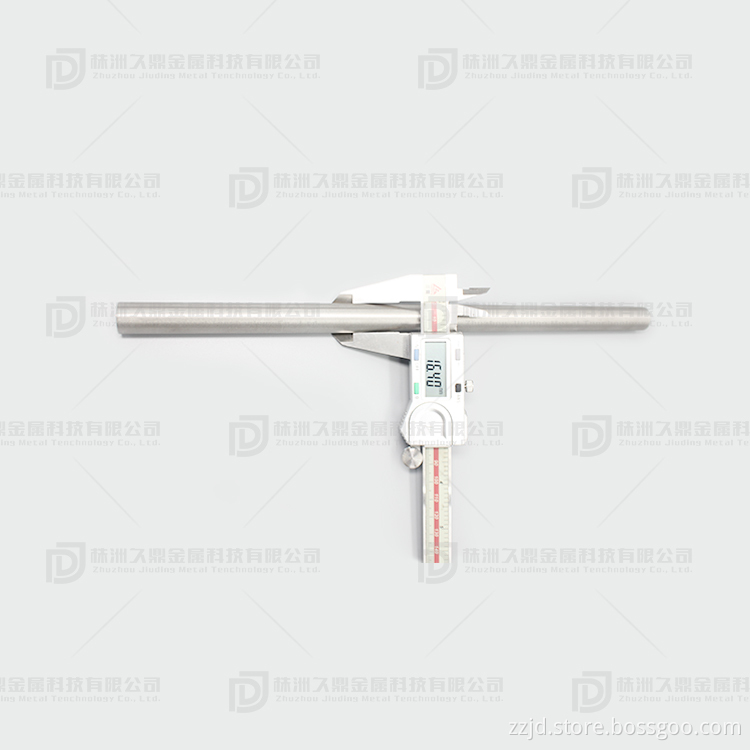
Tungsten heavy alloy rods are specialized high-density materials engineered specifically for the demanding environment of oil logging and exploration. Composed primarily of tungsten with nickel, copper, or iron binders, these rods offer exceptional density ranging from 16.5 to 18.0 g/cm³, making them significantly heavier than traditional steel counterparts.
The extreme density allows for smaller diameter rods to achieve the same weight as larger steel tools. This reduces fluid drag in the wellbore, maintaining higher flow rates and improving overall drilling efficiency.
Oil logging environments often involve harsh chemicals and acidic conditions. Tungsten alloy rods provide superior resistance to corrosion compared to stainless steel, ensuring longer tool life and reduced replacement costs.
Zhuzhou Jiuding Metal Technology Co., Ltd. leverages advanced Metal Injection Molding (MIM) and pressing technologies to produce tungsten alloy rods that meet international quality standards. Our manufacturing process is backed by a dedicated R&D group led by materials science professors, ensuring our products remain at the leading edge of national and international technology.
We are certified to ISO 9001, ISO 14001, ISO 45001, and ISO 13485 standards. These certifications guarantee consistent batch quality, rigorous environmental management, and strict occupational health safety protocols throughout production.
Our facility combines strong funding with state-of-the-art machinery to manufacture both standard and custom non-elevation products. From raw material selection to final machining, every step is monitored to ensure the tungsten rods meet precise density and dimensional tolerances required for oil logging applications.
Selecting the right tungsten alloy rod for oil logging requires balancing density, mechanical strength, and chemical compatibility. Buyers must evaluate specific operational parameters to ensure optimal performance downhole.
Choose between 16.5, 17.0, 17.5, or 18.0 g/cm³ based on the required weight-for-volume ratio. Higher densities allow for more compact designs but may require specific binder systems for toughness.
Ensure the rod has sufficient transverse rupture strength to withstand downhole vibrations and impact loads without fracturing. Look for suppliers who test for TRS, not just compressive strength.
Verify the manufacturer's capability to produce rods to tight tolerances. Custom lengths and diameters reduce the need for secondary machining, lowering your total landed cost.
Use this checklist to evaluate potential suppliers and ensure the tungsten alloy rods meet your operational requirements before placing an order.
As a professional joint venture established in 2001, Zhuzhou Jiuding Metal Technology Co., Ltd. offers a unique combination of academic research backing and industrial manufacturing scale. Our partnership with Central South University provides us with exclusive access to advanced metallurgical innovations.
Unlike standard manufacturers, our R&D group is led by a materials science professor and senior engineers. This ensures our tungsten alloy rods benefit from cutting-edge research and continuous improvement.
Our products are trusted in demanding markets including America, Canada, and Japan. We understand international shipping, packaging, and compliance requirements, simplifying your procurement workflow.
Beyond standard rods, we manufacture swaging rods, bucking bars, and counterbalance weights. Sourcing multiple components from one supplier reduces administrative overhead and ensures material consistency.
While primarily designed for oil logging, the unique properties of tungsten heavy alloys make them suitable for a variety of high-performance industrial applications where density and radiation shielding are critical.
Used as weighting agents in measurement-while-drilling (MWD) and logging-while-drilling (LWD) tools. The high density allows for precise depth control and tool stabilization in horizontal wells.
Tungsten alloy rods are used in syringe shields and vial shields for nuclear medicine. Their ability to block gamma rays protects medical staff while maintaining a compact device footprint.
In aircraft and spacecraft, space is premium. Tungsten rods provide necessary balance in control surfaces and navigation systems without adding excessive volume, optimizing payload capacity.
The high density and hardness make tungsten alloys ideal for military applications requiring kinetic energy penetration, such as armor-piercing ammunition and structural testing equipment.
Common inquiries regarding the specifications, handling, and application of tungsten alloy rods in oil logging and other industries.
Standard tungsten heavy alloy rods typically range from 16.5 g/cm³ to 18.0 g/cm³. The exact density depends on the binder system used (Nickel-Copper, Nickel-Iron, etc.). Higher densities allow for smaller, lighter tools to achieve the same downhole weight, reducing drag in the wellbore.
Tungsten alloy is approximately 1.7 times denser than steel. This means you can use a rod with roughly 60% of the volume of a steel equivalent to achieve the same weight. This reduction in volume improves fluid flow around the tool and reduces the risk of getting stuck in narrow well sections.
Yes. We utilize advanced Metal Injection Molding (MIM) and pressing technologies to produce both standard and custom non-elevation products. We can machine rods to specific lengths, diameters, and tolerances to fit your existing tooling inventory.
Yes, tungsten heavy alloys exhibit excellent resistance to corrosion, particularly against acidic environments commonly found in oil and gas wells. This durability extends the service life of your logging tools and reduces the frequency of replacements.
Our company is certified to ISO 9001 (Quality Management), ISO 14001 (Environmental Management), ISO 45001 (Occupational Health and Safety), and ISO 13485 (Medical Devices). These certifications ensure our manufacturing processes meet rigorous international standards.
About Us
Related Products List
Contact Us

Privacy statement: Your privacy is very important to Us. Our company promises not to disclose your personal information to any external company with out your explicit permission.
Fill in more information so that we can get in touch with you faster
Privacy statement: Your privacy is very important to Us. Our company promises not to disclose your personal information to any external company with out your explicit permission.