


Please Leave Us A Message
Privacy statement: Your privacy is very important to Us. Our company promises not to disclose your personal information to any external company with out your explicit permission.


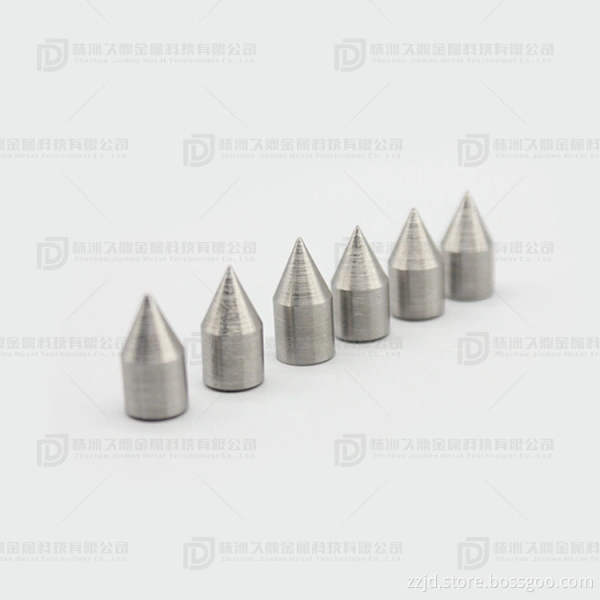
A tungsten alloy bullet head is a high-performance projectile engineered from a composite of tungsten and other metals to achieve superior density and kinetic energy. Unlike traditional lead cores, these projectiles utilize the exceptional physical properties of tungsten heavy alloy (WHA) to deliver consistent aerodynamics and terminal performance.
Manufactured using advanced Metal Injection Molding (MIM) and pressing technologies, these components offer precise geometric control. This ensures that every round meets strict tolerances, reducing variability in flight path and impact accuracy for professional shooters and defense applications.
Significantly denser than lead, allowing for smaller caliber designs with equivalent mass and momentum.
Non-toxic composition eliminates environmental contamination risks associated with lead ammunition.
Advanced MIM technology ensures uniform internal structure and external geometry for consistent ballistics.
Zhuzhou Jiuding Metal Technology Co., Ltd. leverages over two decades of manufacturing expertise to produce premium tungsten alloy bullets. Our facility integrates rigorous quality control systems certified by ISO 9001, ISO 14001, ISO 45001, and ISO 13485 standards.
We utilize state-of-the-art Metal Injection Molding (MIM) and precision pressing techniques. These methods allow us to manufacture both standard configurations and complex custom geometries with tight tolerances. Our R&D group, led by materials science professors and senior engineers, ensures that our production processes remain at the forefront of national and international metallurgy.
Strict material sourcing and processing protocols guarantee that every tungsten alloy bullet head meets high-density requirements and structural integrity standards, minimizing defect rates and ensuring reliable performance in critical applications.
Selecting the optimal tungsten alloy bullet head requires balancing ballistic performance with regulatory compliance and cost efficiency. Buyers must evaluate several critical factors to ensure compatibility with their specific firing mechanisms and target requirements.
Higher tungsten content increases density but may affect machinability. Standard alloys typically range from 85% to 97% tungsten. Verify that the supplier provides material test certificates confirming the exact composition ratio to ensure consistent weight and performance.
Look for manufacturers who employ Metal Injection Molding (MIM) for complex shapes. This technology allows for tighter tolerances on ogive shape and base geometry, which directly impacts aerodynamic stability and feeding reliability in semi-automatic firearms.
Ensure your supplier holds relevant international certifications (ISO 9001, etc.). This indicates a mature quality management system capable of sustaining large-scale production without compromising consistency.
Use this checklist to evaluate potential suppliers and minimize procurement risk when sourcing tungsten alloy bullet heads.
Density Certification: Does the supplier provide third-party lab reports verifying density (typically >17.0 g/cm³)?
Tolerance Data: Are dimensional tolerances explicitly defined for critical features like diameter and ogive length?
Surface Finish: Is the surface free from porosity, cracks, or incomplete filling typical of poor sintering?
Production Capacity: Can the factory scale output to meet bulk order requirements without quality degradation?
R&D Support: Does the supplier have engineering resources to assist with custom design modifications?
Lead Time Reliability: Are historical delivery records consistent with quoted timelines?
The unique physical properties of tungsten heavy alloy make it indispensable across several high-stakes industries. Beyond traditional defense applications, tungsten alloy bullet heads are utilized in specialized fields requiring high mass concentration in small volumes.
Used in armor-piercing rounds and training ammunition where high density enhances penetration capabilities and kinetic energy transfer while maintaining manageable projectile size.
Competitive shooters prefer tungsten cores for their ability to maintain velocity downrange and reduce recoil impulse compared to lead alternatives of similar mass.
Employed in ballistic testing equipment and impact simulation devices where precise, repeatable energy delivery is critical for calibration and data collection.
When selecting a partner for tungsten alloy bullet head manufacturing, consider a supplier with integrated capabilities from raw material processing to finished component machining.
Established in 2001, Zhuzhou Jiuding Metal Technology Co., Ltd. combines advanced MIM technology with traditional pressing methods. This dual-capability approach allows for cost-effective production of both simple and highly complex geometries.
Our R&D team, supported by close cooperation with Central South University, ensures continuous innovation in alloy formulations. This academic partnership keeps our products aligned with the latest advancements in materials science.
With certifications including ISO 9001, ISO 14001, ISO 45001, and ISO 13485, we meet the stringent requirements of international markets. Our customer-oriented philosophy prioritizes clear communication and reliable delivery schedules.
Tungsten heavy alloy bullets typically have a density ranging from 17.0 to 18.0 g/cm³, depending on the specific tungsten-to-binder ratio. This is significantly higher than lead (11.34 g/cm³), allowing for smaller, lighter projectiles with equivalent mass.
Yes. Tungsten is non-toxic and environmentally friendly. Using tungsten alloy instead of lead eliminates the risk of soil and water contamination at shooting ranges, making them compliant with increasingly strict environmental regulations in many countries.
Absolutely. Through our Metal Injection Molding (MIM) and pressing technologies, we can manufacture various non-standard shapes and sizes. Our R&D team works closely with buyers to optimize geometry for specific ballistic performance requirements.
Our company is certified to ISO 9001 (Quality Management), ISO 14001 (Environmental Management), ISO 45001 (Occupational Health and Safety), and ISO 13485 (Medical Devices). These certifications ensure consistent product quality and reliable manufacturing processes.
Metal Injection Molding allows for the production of complex geometries with high precision and excellent surface finish. It enables near-net-shape manufacturing, reducing secondary machining costs and material waste while ensuring uniform microstructure throughout the component.
About Us
Related Products List
Contact Us

Privacy statement: Your privacy is very important to Us. Our company promises not to disclose your personal information to any external company with out your explicit permission.
Fill in more information so that we can get in touch with you faster
Privacy statement: Your privacy is very important to Us. Our company promises not to disclose your personal information to any external company with out your explicit permission.